You close the laptop, stand up, and your neck does not stand up with you. It feels heavy. The base of your skull is tight. Turning to check a blind spot on the drive home is shorter than it should be. By the time you get to the gym, your traps are already doing extra work.
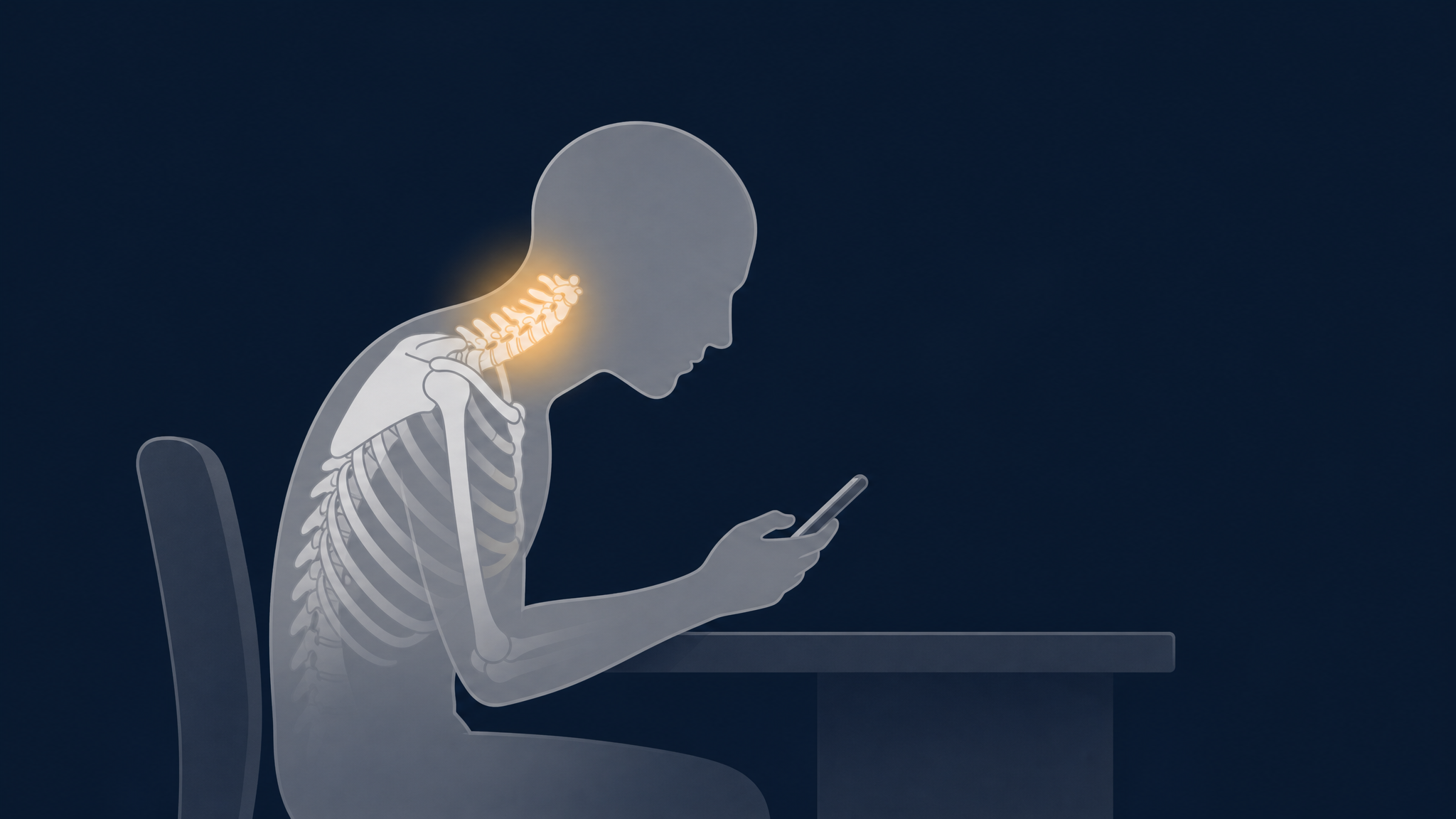
That pattern has a name. Tech neck is forward-head posture from phones, laptops, and long desk days. Your head sits in front of your shoulders instead of stacked over them. The joints in your neck and upper back take load they were not set up to hold for eight hours.
It is common. It is mechanical. It is not a sign that something mysterious is "wrong with your neck forever." At Prime Wellness Chiropractic in Penshurst, this is one of the most ordinary stories we hear from desk workers, professionals, and people who train after work.
Your head weighs a fair bit. When it sits over your shoulders, the cervical spine shares that load well. When it drifts forward to follow a screen, the muscles at the back of the neck and the joints in the upper cervical spine work overtime. The mid-back often rounds to match. The shoulders follow.
That is why the pain is not only in one sore muscle. People describe:
Phones make it sharper because the screen is lower. Laptops do the same when the display sits below eye height. You are not weak for feeling it. You are holding a posture your joints were not meant to hold all day.
This is educational information, not a diagnosis. If your neck pain started after trauma, or you have rapidly worsening arm weakness, see a doctor.
Hours at a laptop flatten the upper back and slide the head forward. You notice it when you stand: the neck is stiff, the shoulders sit high, and looking up at a monitor in a meeting feels like work. A short walk helps. The next sitting block puts the same load back on.
That loop is why stretching the traps at 3pm can feel good and still leave you in the same place tomorrow. The stretch changes the muscle for a few minutes. It does not change how the neck and upper back are sharing load.
Gym-goers and athletes often feel tech neck in the session after work. Presses, pulls, and anything that asks the upper back to brace will grab a neck that has been hanging forward all day. The lift is not always the problem. The leftover restriction is.
If your mid-back will not extend and your neck is already tired, the traps and upper cervical joints pick up the slack. That is a fast way to turn a desk ache into a training ache.
For some people the neck is not the loudest complaint. The headache is. When the upper cervical joints are restricted and the muscles at the base of the skull are overworked, pain can refer into the head. We wrote about that pattern in how chiropractic care can help when migraines start in the neck.
Useful care starts with finding what is restricted, then restoring movement and changing the load. Not a generic "sit up straight" lecture, and not an endless stretch list.
Dr Leonardo Abboud (chiropractor) and Dr Rickardo Abboud (chiropractor) assess the neck and upper back together. Range of motion, joint movement, how your head sits over your shoulders, and how you sit and train all matter. You should leave the first visit knowing what is driving the stiffness, not just a label of "tech neck."
We treat on the first visit.
When the neck joints are restricted, nearby muscles brace. When the mid-back will not extend, the neck has nowhere to stack. Restoring that movement is often what people notice first: turning is easier, the trap "burn" drops, and looking at a screen does not immediately reload the same spot.
That is the work behind our neck pain and headache care. The neck and the upper back are one system. Treating only the sore trap usually does not last.
You do not need a perfect studio. A few changes reduce the forward-head load:
These are resets, not a treatment plan:
If a movement sharp-catches or sends pain into the arm, stop and get it checked.
Stretching the traps, pecs, and neck still has a place. It is not enough on its own when:
That is when targeted care for the cervical and thoracic spine is the more useful next step. Assessment, joint movement, a desk that does not fight you, and a few resets can help when stretching has already had a fair go and the pattern keeps repeating.
If the pain refers into the arm, that is a different conversation than a tired trap. Come in and get it assessed rather than stretching harder.
If the neck starts after lunch, eases when you walk, and is back on the drive home, the load is coming from how you sit and how the neck and mid-back are moving. Not from a lack of willpower.
If your first working sets feel like your neck is already tired, get the desk day out of the joints before you load them. You can keep training. You do not have to keep loading a restricted neck.
If you have a favourite doorway stretch that helps for an hour and then the same tightness is back, you are treating the muscle. The joints still need to move, and the screen height still needs a look.
Prime Wellness Chiropractic is inside Priceline Pharmacy, 2/35 Penshurst St, Penshurst. Monday to Friday 8am to 6pm, Saturday 9am to 5pm, Sunday closed. Walk-ins and same-day appointments are welcome. Book online or call 0468 094 784.

Get expert Chiropractic care right in Sydney. Our experienced team is here to help you restore mobility, reduce pain & get back to doing what you love.