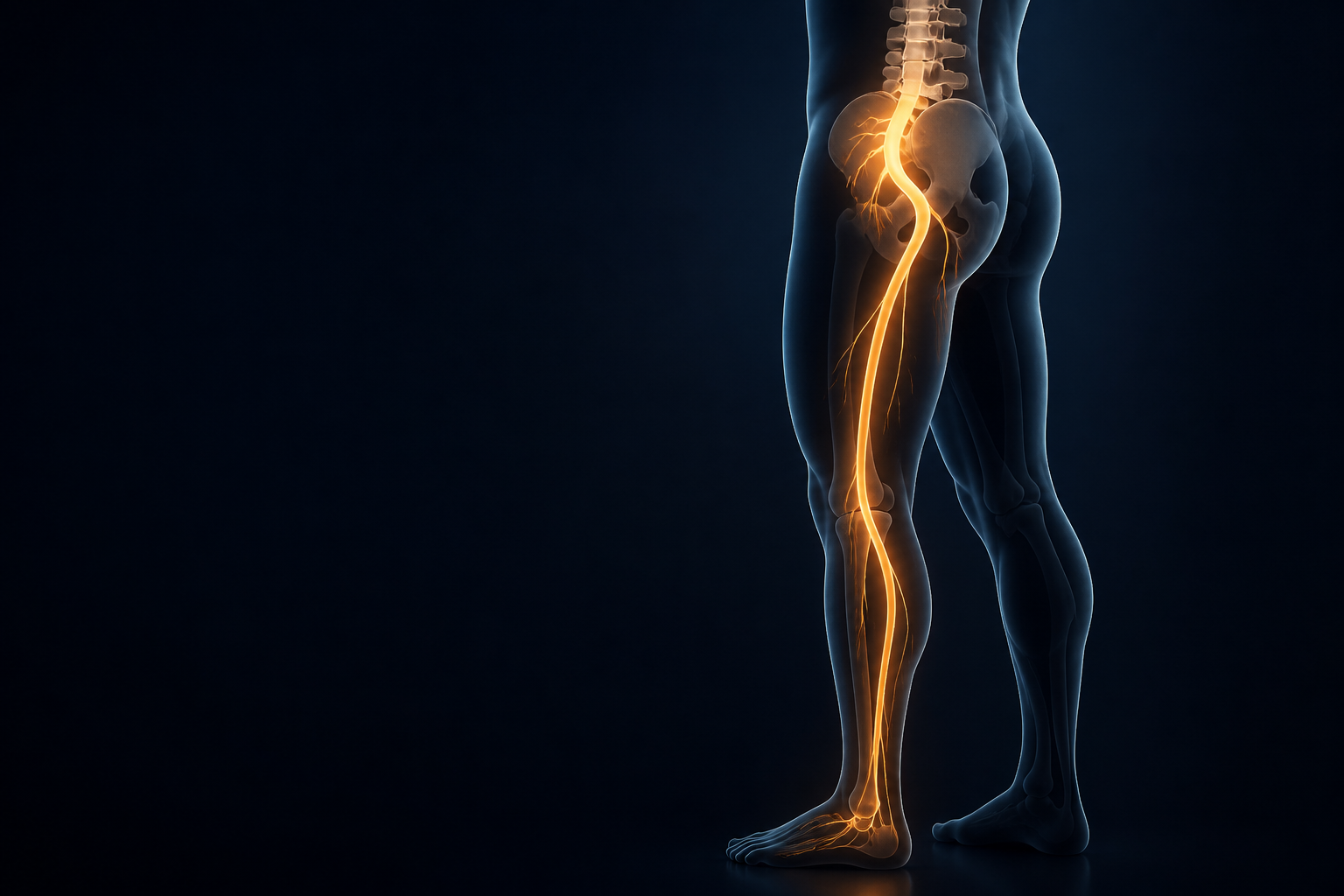
That sharp line down the back of your thigh, the burning in your calf, the pins and needles in your foot. It feels like a leg issue. Most people treat it that way. They stretch the hamstring, foam-roll the glute, rest for a few days, and it eases. Then it comes back.
Sciatica is nerve irritation. The sciatic nerve starts in the lower back, travels through the pelvis and glute, and runs down the leg. When something in that chain loads the nerve, a restricted lumbar joint, a disc that is not handling load well, or a tight hip that is compensating, the pain shows up further down the line.
The leg is where you feel it. The source is usually higher up.
At Prime Wellness Chiropractic in Penshurst, that is the first thing we explain. If you only chase the symptom in the hamstring, the nerve keeps getting irritated the next time you sit, lift, or drive.
Sciatica returns when the thing that is loading the nerve never gets addressed. Stretching can take the edge off. It does not change how your lower back, hips, and discs share load.
Hours at a desk flatten the lower back, load the discs, and tighten the hips. The nerve has less room to move. You stand up, walk it off, and it feels better, until tomorrow's sitting block does the same thing again.
Desk workers often describe the same loop: stiff after lunch, easier after a walk, worse again on the drive home. That pattern is mechanical. It is not a mysterious leg problem that stretching will eventually solve.
Gym-goers often flare sciatica after a heavy pull, a rounded set, or a week of volume with a stiff lower back. The lift is not always the villain. Restricted joints above or below the hips force the lumbar spine to do work it is not set up for. The nerve pays for that extra load.
If your hinge is stiff, your hips do not share the work, or last week's tweak never fully settled, the next hard session can light the same line down the leg.
An old back tweak, a stiff segment in the lumbar spine, or a pelvis that is not moving evenly can keep the nerve on edge even after the original pain fades. The flare settles. The restriction stays. The next long drive or heavy session brings it back.
Hamstring stretches, glute rolling, and rest treat the downstream complaint. If the lower back is still restricted and the disc is still taking extra load, the nerve gets irritated again. That is why the stretch works for two days and then stops lasting.
Useful care starts with finding where the nerve is being loaded, then restoring movement and changing the load. That is assessment first, then treatment, then rehab. Not a cookie-cutter plan, and not an endless maintenance loop.
Dr Leonardo Abboud (chiropractor) and Dr Rickardo Abboud (chiropractor) assess the lower back, hips, and nerve tension together. Range of motion, joint movement, disc and nerve load, and how you sit and lift all matter. You should leave the first visit knowing what is driving the pain, not just a label of "sciatica."
We treat on the first visit.
When lumbar and pelvic joints are restricted, nearby tissues compensate. Restoring that movement can take pressure off the nerve and give the disc a fairer share of load. Most people notice the leg symptoms ease when the back starts moving again, not when they stretch harder.
This is the practical part: how you sit, how you hinge, and how much volume you put through a flare. We show you what to keep doing and what to modify so the nerve can settle without you stopping work or training altogether.
Once the acute irritation calms, strength and control help keep it from returning. Hip and core work, better hinge patterns, and simple desk resets matter more than another hamstring stretch. Phase 1 of care is typically twice a week for six weeks, then we reassess.
Come in if the pain keeps returning, if stretching only lasts a day or two, or if you have numbness, tingling, or weakness in the leg. Walk-ins and same-day visits are welcome. This is educational information, not a diagnosis. If something feels off, get it checked.
If sitting starts the ache and standing or walking eases it, the nerve is often being loaded from the lower back and hips, not from a tight hamstring that needs more stretching.
If deadlifts, rows, or a heavy week keep lighting up the same line down the leg, form and leftover joint restriction are worth checking before you just deload forever.
If you have a favourite stretch that helps for a day and then the same pain is back, you are treating the leg. The nerve still needs the source unloaded.
Stretching still has a place. Our guide to 5 stretches for lower back pain is a useful starting point when the back is stiff and you need something you can do on the floor with no equipment.
It is not enough on its own when:
That is when targeted care for sciatica and nerve pain or low back pain is the more useful next step. Assessment, joint movement, load management, and rehab can help when stretching has already had a fair go and the pattern keeps repeating.
Prime Wellness Chiropractic is inside Priceline Pharmacy, 2/35 Penshurst St, Penshurst NSW. We are open Monday to Friday 8am to 6pm and Saturday 9am to 5pm. Sunday is closed.
Walk-ins and same-day appointments are welcome. Book online or call 0468 094 784.

Get expert Chiropractic care right in Sydney. Our experienced team is here to help you restore mobility, reduce pain & get back to doing what you love.